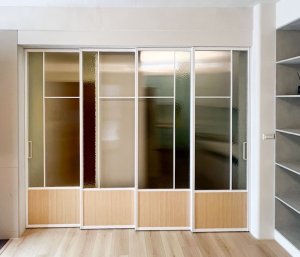
What Is a Balcony Aluminum Louver? What Styles Are Available ?
In the construction market, residential exteriors have increasingly emphasized materials that are sleek, durable, breathable, and capable of providing both privacy and aesthetic value. As a result, louver-style exterior façades and balcony screens have become especially popular. Among them, balcony aluminum louvers are one of the most commonly used exterior decorative and shading materials for developers, interior design firms, homeowners, and renovation contractors. This is not only because of their modern appearance, but also due to aluminum’s weather resistance, lightweight structure, high workability, and suitability for Taiwan’s humid and high-sunlight climate.
However, for many homeowners, the real concerns are not simply whether it looks good, but rather:
-
What are the characteristics of the material?
-
What different louver styles and arrangements are available on the market?
-
Why do prices vary significantly between suppliers?
-
Will installation affect ventilation, natural light, or fire safety?
-
How should a reasonable quotation be evaluated?
From the perspectives of construction sites, aluminum extrusion factories, and professional design planning, this article provides a comprehensive breakdown of the entire process—from design → material selection → fabrication → surface treatment → installation → pricing—so that you have clear evaluation standards before speaking with a contractor. This ensures you avoid misleading sales tactics and instead make a choice that is functional, attractive, cost-transparent, and long-lasting.
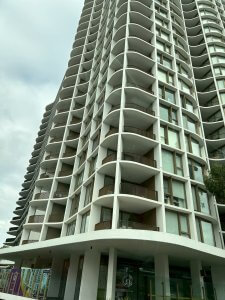
Material Definition and Structural Characteristics of Aluminum Louvers
To understand why aluminum louvers are widely used instead of wood, iron, or stainless steel, we must look at the inherent characteristics of aluminum alloys:
-
Lightweight yet Strong
Aluminum has roughly one-third the density of steel, making it much lighter at the same size. However, once alloyed and extruded into structured profiles, it provides sufficient strength to withstand continuous wind pressure when installed on exterior walls. This means that in high-rise buildings or coastal environments, louvers are less likely to deform due to wind force or temperature changes.
-
Highly Corrosion-Resistant
Taiwan’s coastal regions~especially the North Coast, East Coast, and offshore islands such as Penghu, Kinmen, and Matsu~have salt-laden air that accelerates corrosion. Iron components may rust and peel within just a few years if not treated properly. Aluminum, on the other hand, forms a natural oxide layer that protects the material, and when combined with anodizing or powder coating, delivers even greater weather durability.
-
High Flexibility in Fabrication
Aluminum extrusion allows for customized profiles through mold-based manufacturing. This enables various cross-sectional shapes, such as square tubes, oval tubes, fin-type blades, solid bars, U-channels, and T-frames. Designers can therefore create vertical, horizontal, diagonal, dense, spaced, or layered visual effects without structural limitations.
-
Low Maintenance Cost
Louvers can be cleaned with water and neutral detergent. They do not require periodic oiling like wood, nor regular rust removal and repainting like iron.
With these key characteristics, balcony aluminum louvers are particularly suited to Taiwan’s humid climate and strong temperature variations, providing long-term stability with minimal deterioration while maintaining a modern architectural appearance.
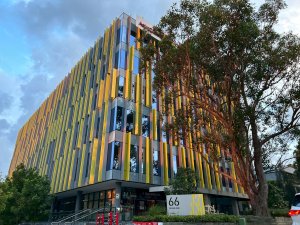
Aluminum Louver Fabrication Process and Common Styles
-
The Aluminum Extrusion Process~ The Key to Quality
Aluminum louvers are not simply “cut and installed” materials; they involve multiple metalworking stages:
- Alloy formulation ~ Choosing structural grades such as 6063 or 6061
- Mold creation~ Cross-section shape determines visual style and shading density
- Extrusion ~ Heated aluminum is pushed through a mold to form continuous profiles
- Straightening & cutting~ Ensures dimensional accuracy and alignment
- Surface finishing:
- Anodizing (matte finish, strong metallic texture, excellent durability)
- Powder coating (rich colors, strong surface resilience)
- Wood-grain transfer (wood appearance without decay or pests)
-
Common Louver Styles (will vary according to site conditions)
| Style Type | Appearance | Suitable Applications | Key Features |
| Vertical | Clean and minimal | Modern façades, balconies | Strong privacy and clear linear expression |
| Horizontal | Strong architectural lines | Commercial buildings, façade walls | Enhanced perspective and depth |
| Diagonal | High design emphasis | Premium residences, new development façades | Effective sun control and distinctive visual identity |
| Blade/Finned | Contemporary, futuristic | Modern residences | Balanced shading and airflow with dimensional layering |
-
Installation Details and Common Mistakes
Many louver failures are caused not by poor material, but by improper construction, such as:
- Misalignment of support frames ~ resulting in visible uneven spacing
- Overly dense spacing ~ reduces ventilation and may trap moisture
- Non-compliance with local façade regulations~ older apartments may require approval when modifying external appearance
Therefore, professional on-site evaluation is essential before finalizing design and installation.
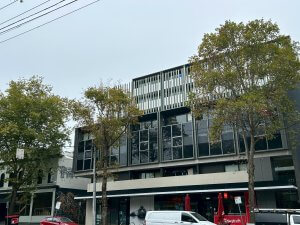
Advantages, Application Scenarios, and Pricing
-
Key Advantages of Aluminum Louvers
- Highly customizable appearance
- Rust-free and weather-resistant
- Lightweight with minimal load on exterior walls
- Compatible with a variety of colors and finishes
- Long service life (typically 15–25 years or more) with minimal maintenance
-
Common Application Areas
- Residential balconies and terraces
- Community courtyards and covered walkways
- Schools and public building shading systems
- Commercial storefront façades
- Carports and skylight screening structures
Suitable for new buildings, renovation, and exterior façade upgrades.
-
How Pricing Is Calculated
| Pricing Factor | Description |
| Profile thickness & shape | Thicker or complex sections cost more |
| Surface finishing | Wood-grain > Powder coating > Anodizing |
| Site installation conditions | Height, scaffolding, lifting, access difficulty |
| Louver density and spacing | More material per square meter increases cost |

Balcony aluminum louvers offer design flexibility, strong durability, long service life, and low maintenance requirements, making them ideal for Taiwan’s climate and concrete-based architecture. However, the final quality depends not only on material selection, but also on profile design, fabrication accuracy, structural framing, and precise installation alignment.
If you want a durable, structurally sound, visually appealing, and fairly priced louver system, it is recommended to work with a supplier experienced in aluminum extrusion and on-site installation.
For custom profile development, co-extrusion, composite processing, or surface finishing services, feel free to contact【Yuan-Cheng Aluminum Co., Ltd.,】 Aluminum in Tainan, Taiwan.
contact us
what’s app >>