YCAL Wood-Grain 【Aluminum Fencing】 and Aluminum Louver Sizes & How to Calculate Pricing
In an era when both residential and commercial projects place increasing emphasis on façade design and long-term durability, Aluminum Fencing (鋁圍籬) and Aluminum Louvers (鋁格柵) have gradually become the mainstream materials replacing traditional ironwork and timber. In the past, many property owners preferred wood, wrought iron, or stainless steel. However, as typhoons become more frequent, sea breeze corrosion intensifies, and the climate grows more humid year by year, the drawbacks of these materials have become obvious: wood rots, stainless steel can rust in harsh environments, and ironwork requires periodic repainting and maintenance.
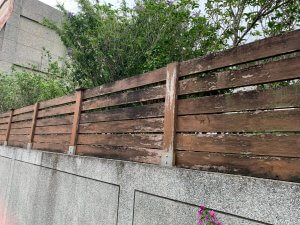
By contrast, extruded aluminum has rapidly gained popularity in the market thanks to its lightweight nature, excellent weather resistance, high degree of design customization, and low-maintenance characteristics.
Within the field of aluminum extrusion, YCAL Far Cheng Aluminum has accumulated many years of manufacturing experience and has become a key partner for developers, construction companies, interior and exterior design firms, as well as individual homeowners. Among their products, wood-grain Aluminum Fencing has become one of the most popular exterior materials because it combines the warm, natural look of wood grain with the durability and weather resistance of aluminum. This is especially true in coastal cities such as Tainan, Taichung, Kaohsiung, and Keelung, where wood-grain aluminum fences are now a staple choice for both new builds and renovation projects.
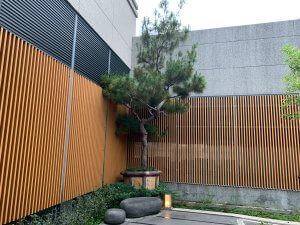
Wood-Grain Aluminum Fencing – Features, Sizes, and Production Process
Wood-grain Aluminum Fencing is currently one of the most popular exterior wall and boundary materials. The reason is not only its appearance, but more importantly, its intrinsic properties, which are perfectly suited to Taiwan’s climate: high humidity, strong sea breeze, powerful typhoons, and intense UV exposure.
Details are as follows:
(1) Core Features of Wood-Grain Aluminum Fencing
Wood-grain aluminum fences offer the following key characteristics:
① High weather resistance – withstands typhoons, UV, and salt spray in Taiwan
Taiwan has a maritime climate. Traditional wooden fences often begin to rot, mold, and darken within just 2–3 years. Aluminum, however, does not absorb water and is not susceptible to termite damage. Combined with a wood-grain transfer coating that provides UV and corrosion resistance, wood-grain Aluminum Fencing can be used outdoors for 10–20 years or more under normal conditions.
② Warm wood-like appearance with virtually no maintenance
Wood-grain Aluminum Fencing preserves the warm, natural look of timber, but requires no preservatives, no oiling, and no repainting. It does not need special maintenance throughout the year, significantly reducing the burden on property owners.
③ Installation-friendly and structurally stable
Aluminum is lightweight, strong, and easy to assemble~these are the biggest advantages of aluminum extrusion. Wood-grain Aluminum Fencing is based on a modular system, combined with aluminum posts, horizontal members, and fixing brackets. On-site installation is fast, dimensional tolerances are small, and the work environment is cleaner compared to steel welding.
④ Corrosion-resistant, non-deforming, and color-stable
Aluminum itself does not rust, and the wood-grain transfer film can withstand temperatures up to around 200°C without peeling under normal use. In contrast, iron fences often require repainting every 2–3 years. Aluminum solutions are therefore almost maintenance-free.
⑤ High degree of customization
Aluminum extrusions can be customized according to project needs, including:
- Custom profile cross-sections
- Adjustable spacing (more privacy vs. more daylight)
- Various wood-grain colors (e.g., white oak, teak, rosewood, walnut, etc.)
- Different layouts and styles (vertical, horizontal, louver-type designs)
This level of flexibility is something solid wood systems simply cannot achieve.
(2) Common Sizes and Specifications for Wood-Grain Aluminum Fencing
Commonly used specifications can be grouped into the following types:
① Slat widths of 50 mm and 60 mm (most common)
Suitable for typical residential communities and townhouses, providing a clean, balanced appearance.
② Slat widths of 80 mm and 100 mm
Frequently used in luxury residences or commercial buildings. The visual effect is wider and more substantial, with a stronger presence.
③ Thickness (t) by application
Typical thicknesses include:
- t = 1.2 mm
- t = 1.5 mm
- t = 2.0 mm
Thickness directly affects wind-load resistance and cost, making it a critical factor in quotations.
④ Fence height
Common fence heights include:
- 100 cm
- 120 cm
- 150 cm
- 180 cm
The higher the fence, the greater the wind load. As a result, post spacing must be reduced, and overall cost will increase accordingly.
(3) Production Process of Wood-Grain Aluminum Fencing
From raw aluminum billet to finished wood-grain fencing, the process can be divided into these stages:
① Aluminum extrusion forming
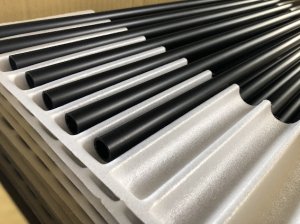
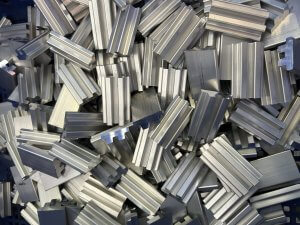
Aluminum billets are extruded through a press and shaped by specialized dies to produce various profiles such as fence slats and posts.
② Degreasing and pre-treatment (surface cleaning)
Oils and impurities are removed from the surface to ensure proper adhesion of subsequent powder coating.
③ Powder coating
A transparent or resin powder is applied and cured in an oven at approximately 180–200°C, forming a durable, weather-resistant coating film.
④ Wood-grain thermal transfer
A wood-grain film is wrapped around the coated aluminum and processed under vacuum and high temperature so that the wood pattern is fully transferred onto the surface. The final texture appears natural and closely resembles real wood.
⑤ Inspection, cutting, and packaging
Color uniformity and film integrity are checked. Profiles are then cut to size and packaged for shipment.
The overall production process directly determines weather resistance and product quality. Professional manufacturers in Taiwan have extensive experience controlling color consistency and adhesion of the wood-grain film, resulting in highly stable, reliable products.
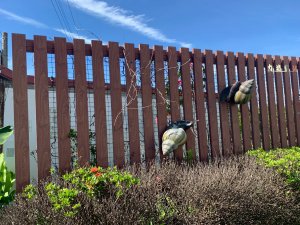
Aluminum Louvers – Sizes, Applications, Structural Design, and Fabrication
Aluminum louvers are widely used by homeowners, architects, and contractors for balcony screening, façade treatments, mechanical room covers, and fence backing panels. With high flexibility, a modern look, and low weight, louvers are heavily employed in both new developments and renovation projects.
(1) Core Features of Aluminum Louvers (Performance, Durability, Structure)
① Moisture-proof, no swelling, no deformation
Louvers are often installed in high-temperature, high-humidity locations such as extended balconies, mechanical room façades, and screening platforms. Aluminum offers excellent UV resistance and thermal stability, making it one of the most durable options in these environments.
② Lightweight with low structural load
For older buildings adding balconies or structures with limited load capacity in their reinforced concrete (RC) frames, aluminum louvers are much safer than iron or wood, reducing structural stress.
③ Corrosion-resistant, acid- and alkali-resistant, moisture-resistant
Coastal cities like Keelung, Tamsui, Tainan, and Kaohsiung are especially prone to rust issues. Aluminum louvers are highly resistant to such corrosion, providing a long-lasting solution.
④ High modularity and fast installation
Aluminum extrusion profiles can be customized in cross-section. Common shapes include:
- U-shaped profiles
- Square tubes
- Flat tubes
- Various finishes such as gunmetal grey, black textured finishes, solid colors, and wood-grain coatings
This greatly enhances flexibility and creativity in architectural design.
(2) Louver Fixing Methods and Structural Details
Installation quality for aluminum louvers can vary greatly. Common fixing methods include:
① Concealed fixing
Screws are hidden on the back side, leaving the front face clean without visible fastening points.
② L-shaped and U-shaped frame fixing
Suitable for larger louver assemblies requiring higher structural strength.
③ Interlocking modular systems
Assembly is fast, with minimal error; this method is ideal for large-scale installations such as community boundary walls or project façades.
(4) Production Process for Aluminum Louvers
Similar to wood-grain Aluminum Fencing, the production process for aluminum louvers generally includes:
- Extrusion
- Surface pre-treatment
- Powder coating (available in black, white, grey, brown, and various wood-grain finishes)
- Custom cutting to length
- Quality inspection and packaging
- On-site assembly and installation
The key factors are color consistency and surface flatness. Professional manufacturers will inspect color variation, coating thickness, and anodizing or powder-coating quality before shipment to ensure a uniform building appearance and avoid issues such as “one section darker, one section lighter.”
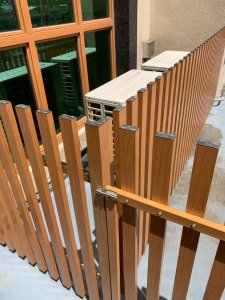
How to Calculate Pricing for Aluminum Fencing and Aluminum Louvers?
When asking for a quote, many homeowners will ask questions like:
- “How much per meter?”
- “Is wood-grain more expensive than regular colors?”
- “Is it cheaper if the louver panels are larger?”
Pricing for aluminum materials follows a clear logic. Below is a concise breakdown:
(1) Four Key Factors in Price Calculation
① Aluminum weight (kg)
Extruded aluminum is priced by weight. The basic formula is:
Weight (kg) × Current-month aluminum price (raw material) × Processing cost = Base material cost
The aluminum price fluctuates monthly and is the foundational factor affecting cost.
② Surface treatment (powder coating vs. wood grain)
From lowest to highest unit cost, the finishes typically rank as:
- Mill finish (natural aluminum, lowest cost)
- Black/white textured powder coating (standard powder finish)
- Special colors (e.g., charcoal grey, bronze, champagne)
- Wood-grain thermal transfer (highest cost)
Wood-grain finishes are more expensive mainly due to:
- The cost of transfer films
- High-temperature processing requirements
- Strict color-matching and visual consistency demands
③ Size (slat width, thickness, spacing)
Three major factors directly affect cost:
- Wider slats → more material weight → higher cost
- Thicker profiles → higher strength → higher cost
- Tighter spacing → more pieces per meter → higher cost
For example:
- 1 cm spacing → high privacy but higher cost
- 3 cm spacing → fewer materials required, lower cost
④ Installation cost (labor)
Labor costs vary by city, floor level, and installation complexity:
- Taipei: higher labor cost
- Taichung, Tainan: mid-range
- Kaohsiung, Pingtung: slightly lower
If the project requires:
- High-altitude work
- Scaffolding
- Transport into mountain or remote areas
The price will increase accordingly.
(3) Why Do Quotes Vary So Much Between Different Suppliers?
The main reasons include:
- Differences in material thickness
- Whether extrusion dies are owned and maintained in-house
- Whether the wood-grain finish is truly high weather-resistance grade
- Variations in installation methods and workmanship
- Extent of outsourcing for processing steps
These factors all impact long-term durability, visual consistency, and total project cost.

From façade design, durability, maintenance cost, to installation flexibility, wood-grain Aluminum Fencing and aluminum louvers are arguably the materials that best match Taiwan’s environment and contemporary aesthetics. They do not rot, do not rust, need no oiling, and require no repainting. At the same time, they offer customizable colors, dimensions, and visual styles, significantly elevating the overall look of a building façade and helping residential or commercial spaces maintain a clean, sharp appearance even after ten or twenty years.
Whether you are facing any of the following situations:
- Selecting a stable and durable exterior material for a new project
- Renovating an older property and looking to improve appearance, daylight, or privacy
- Enhancing safety and visual appeal for a townhouse or single-family home
- Creating a modern façade effect for a commercial building using louvers
Extruded Aluminum Fencing and louvers can provide an ideal solution. The true determinant of long-term performance, however, is not only the material itself but also a reliable aluminum extrusion manufacturer. Stability in processing, consistency of wood-grain color, sufficient thickness, and sound structural design~these technical details collectively decide whether the material can withstand ten or twenty years of sun, wind, and rain.
For any needs such as custom development, co-extrusion, composite processing, or surface finishing, you are very welcome to contact 【Yuan-Cheng Aluminum Co., Ltd.,】 in Tainan, Taiwan for professional service and support.
contact us
what’s app >>