Material Characteristics of Aluminum Alloys
Aluminum alloy is the most commonly used primary material for interior partitions and grilles. Pure aluminum is lightweight, corrosion-resistant, and easy to process, but its strength is relatively limited. Therefore, in practical engineering applications, elements such as magnesium, silicon, manganese, copper, or zinc are commonly added to produce aluminum alloys with different mechanical properties.
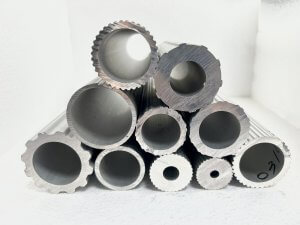
Among aluminum extrusion materials used in interior decoration, 6000-series aluminum alloys, such as 6061 and 6063, are particularly common. These alloys offer excellent extrudability, good surface finishing performance, and stable structural properties. They are suitable for manufacturing square tubes, flat tubes, round tubes, guide rails, framing profiles, decorative trims, and customized cross-sectional profiles.
- 6063 aluminum alloy provides relatively consistent and controllable surface quality. After extrusion, it produces smooth and straight profile lines, making it suitable for partition frames, grilles, and decorative trims with high aesthetic requirements.
- 6061 aluminum alloy generally offers greater strength and is suitable for components that need to withstand heavier loads, tensile forces, or structural stress. The actual material selection should still be comprehensively evaluated according to product thickness, cross-sectional design, span, and fastening method.
Another important characteristic of aluminum alloy is that it is lighter than steel. When grilles are installed on ceilings, walls, or in large high-ceiling spaces, their lighter weight can reduce the load on the building structure while improving handling and installation efficiency.
Processing Procedures for Aluminum Alloys
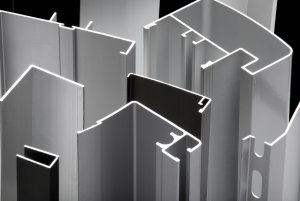
Most aluminum materials used in interior aluminum partitions and grilles first undergo an aluminum extrusion process. The basic principle of aluminum extrusion involves heating cylindrical aluminum alloy billets and then applying pressure through an extrusion press. The aluminum is forced through a specially designed die to form long profiles with consistent cross-sectional shapes.
The die cross-section can be designed according to product requirements, including square, rectangular, circular, grooved, snap-fit, or multi-chamber configurations. When partitions require the installation of glass, rubber gaskets, LED light strips, or panels, grooves, locking points, screw channels, and reinforcing structures can be incorporated directly into the profile cross-section. This reduces the need for subsequent welding or additional components.
After extrusion, the aluminum profiles must undergo straightening, cooling, fixed-length cutting, artificial aging, or heat treatment to ensure that their dimensions and hardness meet the required specifications. The profiles are then processed according to the engineering drawings through sawing, punching, drilling, tapping, milling, CNC machining, bending, assembly, and surface finishing.
For decorative or curved grille designs, roll bending, stretch bending, or forming with specialized fixtures may also be required. During processing, the angles, lengths, hole positions, and dimensional tolerances must be carefully controlled. Otherwise, problems such as inconsistent grille spacing, oversized joints, or poor frame alignment may occur during on-site assembly.
Main Advantages of Aluminum Alloys
The most obvious advantages of aluminum alloys are their lightweight construction, corrosion resistance, high processing flexibility, and clean appearance. In interior decoration, aluminum materials can reduce woodworking dust and minimize the need for extensive wet construction processes. They are also less likely to swell, rot, or suffer insect damage under Taiwan’s humid climate.
Customized extrusion dies can be developed to integrate multiple functions into a single profile cross-section. For example, mounting channels, glass grooves, screw channels, electrical wiring channels, and decorative surfaces can all be incorporated into one profile. This reduces the number of components, speeds up installation, and creates a cleaner and more uniform finished appearance.
In addition, aluminum alloys have excellent recycling value. If partitions need to be dismantled, relocated, or reconfigured in the future, most aluminum components can be disassembled, sorted, and recycled. This supports modern architectural practices that emphasize material reuse, circular construction, and waste reduction.
Common Surface Treatments for Aluminum Partitions and Grilles
The performance of the metal itself is important, but surface treatment also directly affects appearance, wear resistance, corrosion resistance, and ease of cleaning.
-
Anodizing
Anodizing is an electrochemical process that forms an oxide layer on the surface of aluminum. This layer improves corrosion and wear resistance and can produce finishes in silver, champagne, black, bronze, and other tones.
One advantage of anodizing is that it retains the natural metallic appearance of aluminum. The surface color is strongly bonded to the aluminum substrate and is less likely to peel off in large sections like conventional paint. It is suitable for modern-style partitions, grilles, and door frames.
Before anodizing, the aluminum surface must undergo degreasing, cleaning, and pretreatment. If the extruded surface contains die lines, scratches, or uneven coloring, these defects may remain visible after anodizing. Therefore, the quality of the aluminum extrusion, as well as the handling and processing procedures, is extremely important.
- Powder Coating
Powder coating involves applying powdered paint to a metal surface through electrostatic attraction, followed by high-temperature curing to form a durable coating film. It can produce a wide variety of colors and textures, including matte, fine-textured, and smooth finishes.
The main advantages of powder coating are its wide range of color options and excellent covering capability. It can also be coordinated with interior walls, cabinetry, and corporate brand colors. Black, white, gray, and brown are common choices for interior grilles.
During processing, attention must be paid to hanging points, coating thickness, curing temperature, and color consistency. If components will remain visible after assembly, fastening locations should be planned in advance to prevent scratching or damaging the coating during installation.
- Wood-Grain Transfer Printing
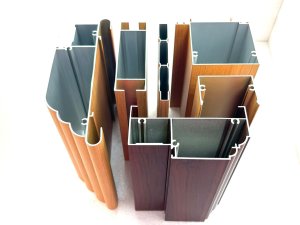
Wood-grain transfer printing gives aluminum surfaces a wood-like pattern and color. The basic process usually involves applying a powder-coated base layer to the aluminum surface, followed by the use of transfer film and heating equipment to transfer the wood-grain pattern onto the surface.
Wood-grain aluminum grilles retain the moisture resistance, corrosion resistance, and insect resistance of aluminum while providing the visual warmth of natural wood. They are suitable for entrances, living rooms, dining areas, ceilings, and commercial spaces.
The quality of wood-grain transfer printing is affected by the base coating, transfer film, temperature, processing time, and profile cross-section. Complex grooves or deeply recessed surfaces may result in uneven pattern transfer. Therefore, the feasibility of surface treatment should be considered during the profile design stage.
- Electrophoretic Coating and Liquid Coating
Electrophoretic coating can form a uniform film over a metal surface and is commonly used for products requiring a refined appearance and a certain degree of corrosion resistance.
Liquid coating is suitable for small production quantities, special colors, or on-site repairs. However, its wear resistance and coating thickness consistency may depend heavily on the skill and quality of the application process.
Each surface treatment has its own suitable applications. Selection should not be based solely on color. The installation environment, cleaning method, frequency of physical contact, budget, and future maintenance requirements must also be considered.
Complete Manufacturing Process for Interior Aluminum Partitions
The production of a stable and high-quality interior aluminum partition system generally begins with on-site measurement and confirmation of project requirements. Designers must understand the floor-to-ceiling height, wall verticality, floor levelness, glass dimensions, door locations, mechanical and electrical pipelines, and fire protection equipment before determining the appropriate partition configuration.
Once the design is completed, the project enters the aluminum profile selection or extrusion die development stage. Standard partition systems can use existing profiles, while customized shapes may require the development of new extrusion dies.
The cross-sectional design must take material thickness, load direction, fastening methods, gasket positions, and assembly sequence into consideration.
After the aluminum profiles have been extruded, they are cut to specified lengths and processed according to the drawings. These procedures may include drilling, punching, tapping, slot milling, and CNC machining. If the system includes steel reinforcement components, stainless steel bases, or specialized hardware, these parts must also be manufactured and trial-assembled at the same time.
The purpose of trial assembly is to verify that the hole positions, dimensions, angles, joints, and accessories are correct. In large-scale projects, discovering incorrect hole positions only after the materials arrive on-site can significantly increase modification time and may also damage the surface finish.
After all processing dimensions have been confirmed, the aluminum profiles undergo anodizing, powder coating, wood-grain transfer printing, or other surface treatments. Once completed, proper protective packaging is required to prevent components from colliding with or scratching one another during transportation and handling.
During on-site installation, the installers first confirm the reference and alignment lines before securing the upper and lower tracks and vertical posts. If the walls or floors are uneven, shims, adjustable components, or finishing materials must be used for correction.
Horizontal members, glass, panels, grille blades, doors, and hardware are then installed. Finally, the installers complete joint filling, gasket placement, silicone sealing, and cleaning.
Key Processing and Installation Considerations for Interior Aluminum Grilles
Aluminum grilles may appear to consist simply of multiple aluminum strips arranged in sequence. However, precise processing is still required to achieve visual uniformity and structural safety.
The width, thickness, depth, spacing, arrangement direction, and fastening method of the grille members must first be determined.
Even minor variations in grille spacing can create a crooked or irregular visual effect when viewed from a distance. Therefore, the cutting lengths and fastening hole positions must remain consistent. Positioning fixtures or modular bases should also be used during installation to ensure that every grille member maintains the same angle.
Ceiling grilles must also take into account suspension point spacing, lighting fixtures, air-conditioning vents, fire sprinklers, and maintenance openings. If the grille completely conceals the equipment, future inspection and repair work may become difficult. Removable, snap-fit, or modular designs are therefore recommended.
For wall-mounted grilles, the wall material must be carefully evaluated. When the grille is installed on a lightweight partition wall, it is necessary to confirm that sufficient internal framing is available.
When it is installed on a concrete wall, suitable expansion anchors or chemical anchors should be selected. Large grilles should not be fastened only to the surface panel, as this may result in loosening over time.
Practical Advantages of Interior Aluminum Partitions and Grilles
- Resistant to Moisture-Related Deformation
Taiwan has a relatively humid climate. When wooden materials absorb moisture, they may swell, warp, develop mold, or experience peeling of surface laminates.
Aluminum alloy does not absorb water and will not rot due to normal indoor humidity. It is suitable for entrances, areas outside bathrooms, spaces near kitchens, and air-conditioned environments.
- Faster Installation
Most cutting, drilling, and surface treatment procedures for aluminum extrusions can be completed in the factory, leaving mainly assembly work for the installation site.
Compared with traditional construction methods that require extensive substrate preparation, putty application, sanding, and painting, modular aluminum partitions can generally shorten the on-site construction period.
- Clean Appearance and Consistent Quality
Aluminum extrusions have fixed cross-sectional shapes and straight profile lines, making them suitable for modern minimalist interiors.
The overall color scheme can also be controlled through anodizing, powder coating, or wood-grain finishing. When the same profiles are used in large quantities, dimensional and visual consistency is easier to maintain.
- Balancing Natural Light and Privacy
Aluminum partitions can be combined with clear glass, fluted glass, frosted glass, tinted glass, or solid panels.
Designers can adjust the level of light transmission according to the requirements of the space, preserving brightness while maintaining an appropriate degree of privacy.
Grilles can control sightlines through blade depth, arrangement angle, and spacing. The interior may be visible from the front but partially concealed when viewed from the side. This makes grilles suitable for entrance areas, meeting areas, reception counters, and semi-open workspaces.
- Easy to Dismantle and Reconfigure
Aluminum partitions assembled with screws, snap-fit components, and modular connectors can be dismantled, relocated, or reassembled in the future.
For rented offices, shopping mall booths, and exhibition spaces, this feature can reduce remodeling costs and minimize demolition waste.
- Convenient Maintenance and Cleaning
Aluminum surfaces are smooth and do not easily absorb stains. For routine cleaning, they can generally be wiped with a soft cloth and a neutral cleaning agent.
If a local component is damaged, a single grille member, finishing trim, or hardware component may be replaced depending on the structural design. It may not be necessary to dismantle the entire partition or grille system.
What Should Be Considered When Selecting Materials for Interior Aluminum Partitions and Grilles?
- First: Confirm the Aluminum Alloy Grade and Material Thickness
Aluminum profiles that appear identical may have significantly different strengths because of variations in wall thickness, cross-sectional reinforcement, and heat-treatment condition.
Quality should not be judged solely by the price of each profile.
- Second: Design the Structure According to Height and Span
Taller partitions, longer grilles, and suspended structures require additional fastening points, reinforcing ribs, or steel framing.
The durability of a material does not mean that it can be used directly for every dimension or span without structural evaluation.
- Third: Consider Surface Treatment and the Installation Environment
Anodizing or powder coating may be suitable for ordinary dry indoor environments.
For locations with high humidity, coastal exposure, or frequent cleaning, higher corrosion-resistance specifications should be adopted. The materials used for screws and hardware must also be carefully selected.
- Fourth: Consider Future Maintenance
When lighting fixtures, air-conditioning systems, fire protection equipment, or electrical wiring are concealed inside grilles or partitions, removable panels or maintenance access spaces must be reserved.
Focusing only on a seamless appearance while ignoring equipment maintenance may result in destructive dismantling in the future.
- Fifth: Confirm How Different Metals Will Be Combined
When aluminum, stainless steel, and ordinary steel come into contact, suitable surface treatments, spacers, gaskets, or isolation measures should be used to reduce the risk of corrosion.
Steel components concealed inside the system must also receive proper rust protection. Anti-corrosion treatment should not be omitted simply because the components are not visible.
- Sixth: Pay Attention to Processing Accuracy
Grille alignment, glass dimensions, door operation, and joint appearance are all related to the accuracy of cutting, punching, CNC machining, and assembly.
Even when high-quality materials are used, excessive dimensional errors can still affect the finished result.
How Should Metal Materials Be Selected According to Spatial Requirements?
For residential entrances or living room grilles, aluminum alloy can be used as the main material and combined with powder coating or wood-grain transfer printing. This provides a balance between appearance, durability, and ease of cleaning.
Office glass partitions can use aluminum extrusion frames combined with stainless steel screws, hinges, pivots, and fastening hardware. If the partition is relatively tall, galvanized steel reinforcement can be added in selected areas.
For shopping malls, hotels, and exhibition spaces that require a premium appearance, aluminum alloy can serve as the base material, while brass trims, mirrored stainless steel panels, or specialized metallic coatings can be added. This approach helps control costs while enhancing the overall visual quality.
For large ceiling grilles, weight, suspension safety, and maintenance requirements should be prioritized. Lightweight aluminum is suitable for extensive use, while suspension rods, mounting bases, and load-bearing components may be made from stainless steel or galvanized steel.
Untreated ordinary steel should be minimized in high-humidity environments. Corrosion-resistant aluminum surface treatments and stainless steel hardware should be selected. If steel reinforcement is used, complete anti-rust protection must be applied.

Although aluminum alloy is the primary material used in interior aluminum partitions and grilles, a complete system commonly incorporates other metals, including stainless steel, galvanized steel, ordinary steel, iron components, copper, and brass.Aluminum alloy is lightweight, corrosion-resistant, easy to extrude, and suitable for a wide variety of surface treatments. It is ideal for producing frames, tracks, vertical posts, and grille blades.
Stainless steel is suitable for screws, bases, pivots, hinges, and high-strength hardware. Galvanized steel and ordinary steel can be used for concealed framing and structural reinforcement, while copper and brass can enhance the decorative quality of the finished space.From a practical perspective, interior aluminum partitions and grilles offer rapid installation, lightweight construction, resistance to moisture-related deformation, modular disassembly and reassembly, convenient maintenance, a wide range of surface options, and high recycling value.
By selecting appropriate materials according to the height, span, load-bearing requirements, humidity, design style, and budget of the space, it is possible to achieve an effective balance among appearance, safety, and long-term durability.
For customized die development, multi-material co-extrusion, composite processing, surface treatment, or other related requirements, please contact 【Yuan-Cheng Aluminum Co., Ltd.,】 in Tainan, Taiwan. Our professional team is ready to assist you.
contact us
what’s app >>